
Nov 16, 2026 | 426 words | 4 min read
20. Milestone 5: Deliver, Present and Reflect#
At a Glance
What you will do: Complete your Design Project Technical Report, present your solution to Mission Control, and then reflect on your own design process.
What you will submit: Your completed team Technical Report (PDF), a team presentation, an individual reflection in Gradescope, and your final CATME peer evaluation.
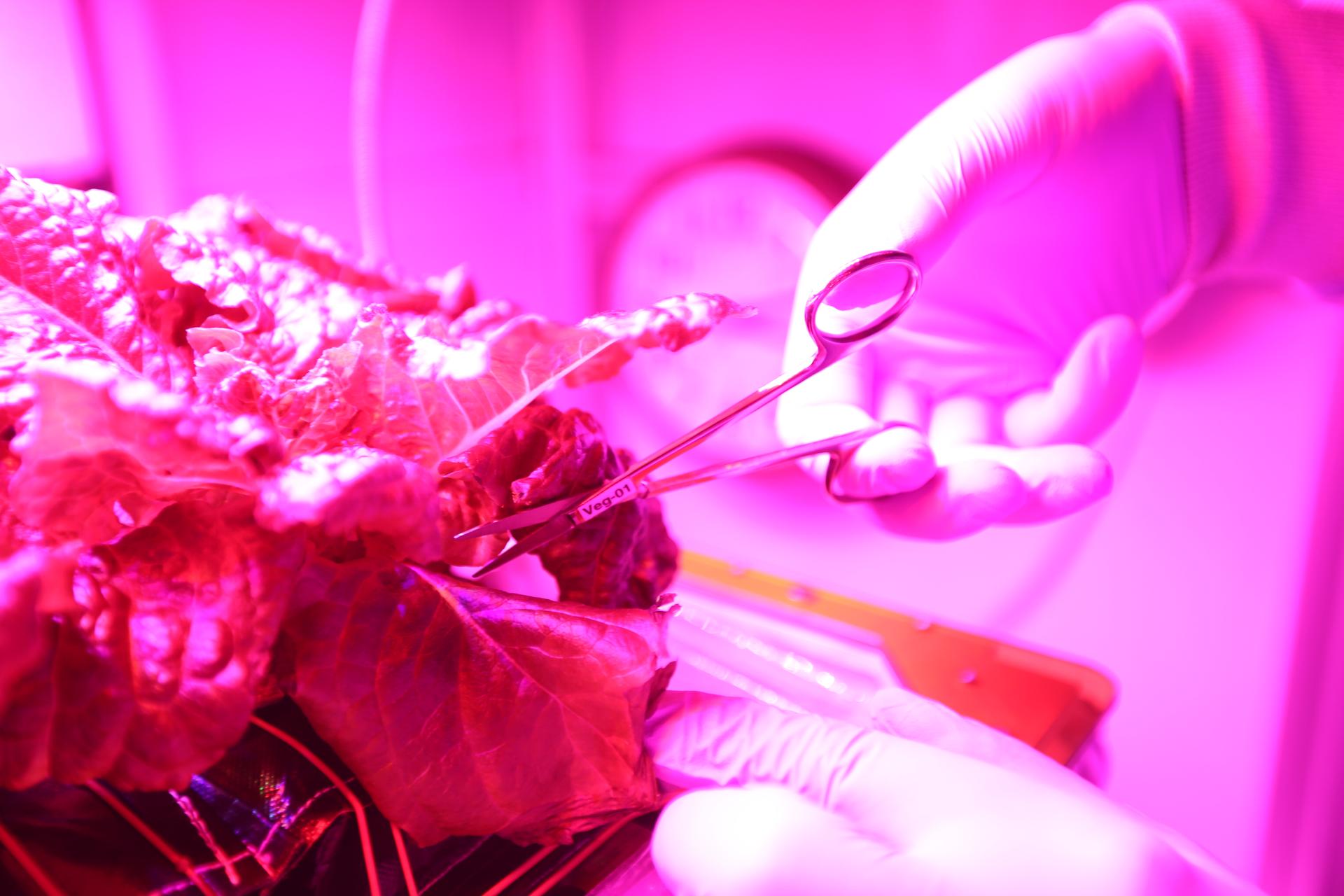
Fig. 20.1 A research scientist harvests ‘Outredgeous’ red romaine from the Veg-03 ground control unit at Kennedy Space Center. Veg-03 is the Earth-based twin of the system flown on the space station. Image source: NASA.#
Mission Control will operate GHU-2 with your software. The people who maintain it on the next mission will have only your report. This milestone is graded the way real deliverables are judged: an engineer who has never met your team must be able to use your work, trust it, and improve it. Your team finishes the report and then presents it.
20.1. Tasks#
Task |
Who |
Deliverable |
|---|---|---|
Individual |
Gradescope activity |
|
Team |
Completed report (PDF) |
|
Team |
Presentation and slides |
|
Final CATME peer evaluation |
Individual |
CATME |
20.2. Your Report This Milestone (TP5)#
Navigate to assignment 20.3 Final Technical Report for instructions on how to complete and submit your team’s final report.
Learning Objectives
- PC01:
Written Communication Standards - Use professional tone, clear sentence structure, and correct spelling and grammar in all written work.
- PC02:
Communicating Results from Analysis - Clearly state conclusions or results derived from code, models, or data analysis.
- PC03:
Captioning Visuals - Include professional captions for all figures, tables, and plots that describe what is shown and why it is relevant.
- PC04:
Visual Communication of Engineering Contexts - Create visuals that clearly communicate engineering data, models, or concepts to a technical audience and support claims or conclusions.
- SQ03:
Trade-offs and Limitations - Explain trade-offs and limitations in the final solution.
- SQ04:
Value Proposition - Present a clear value proposition highlighting benefits and novelty.
- EC01:
Consider Context, Safety, and Uncertainty - Justify engineering decisions or recommendations by considering cultural, economic, environmental, safety, and uncertainty-related factors.
- EC02:
Recognize Limits, Trade-offs, and Confidence - Recognize limitations, trade-offs, and uncertainty in engineering work and communicate appropriate levels of confidence in conclusions.
- EC03:
Make Honest and Responsible Recommendations - Make recommendations that are honest, responsible, and consistent with evidence, while acknowledging broader impacts and professional responsibility.
- AI05:
Communicate clearly and effectively about AI usage and the choices surrounding it in a given field.
- PA01:
Identify Strengths in Process - Identify effective strategies, behaviors, or decisions used during the problem-solving or design process.
- PA02:
Identify Limitations in Process - Identify limitations, challenges, or inefficiencies in the problem-solving or design approach.
- PA03:
Plan for Process Improvement - Identify concrete behaviors or strategies to improve future problem-solving or design efforts.
- TM02:
Document Contributions - Provide clear evidence of individual contributions to the team’s work, including technical, written, or supportive tasks.