
Nov 16, 2026 | 729 words | 7 min read
17. Milestone 2: Understand the System and Generate Ideas#
At a Glance
What you will do: Learn what the greenhouse senses and controls by operating it by hand and analyzing the GHU-1 telemetry log. Then generate and evaluate design ideas, and model the insulation trade-off.
What you will submit: An individual Gradescope activity, a team Failure Investigation, an insulation heat-loss analysis, and your Technical Report checkpoint (TP2).
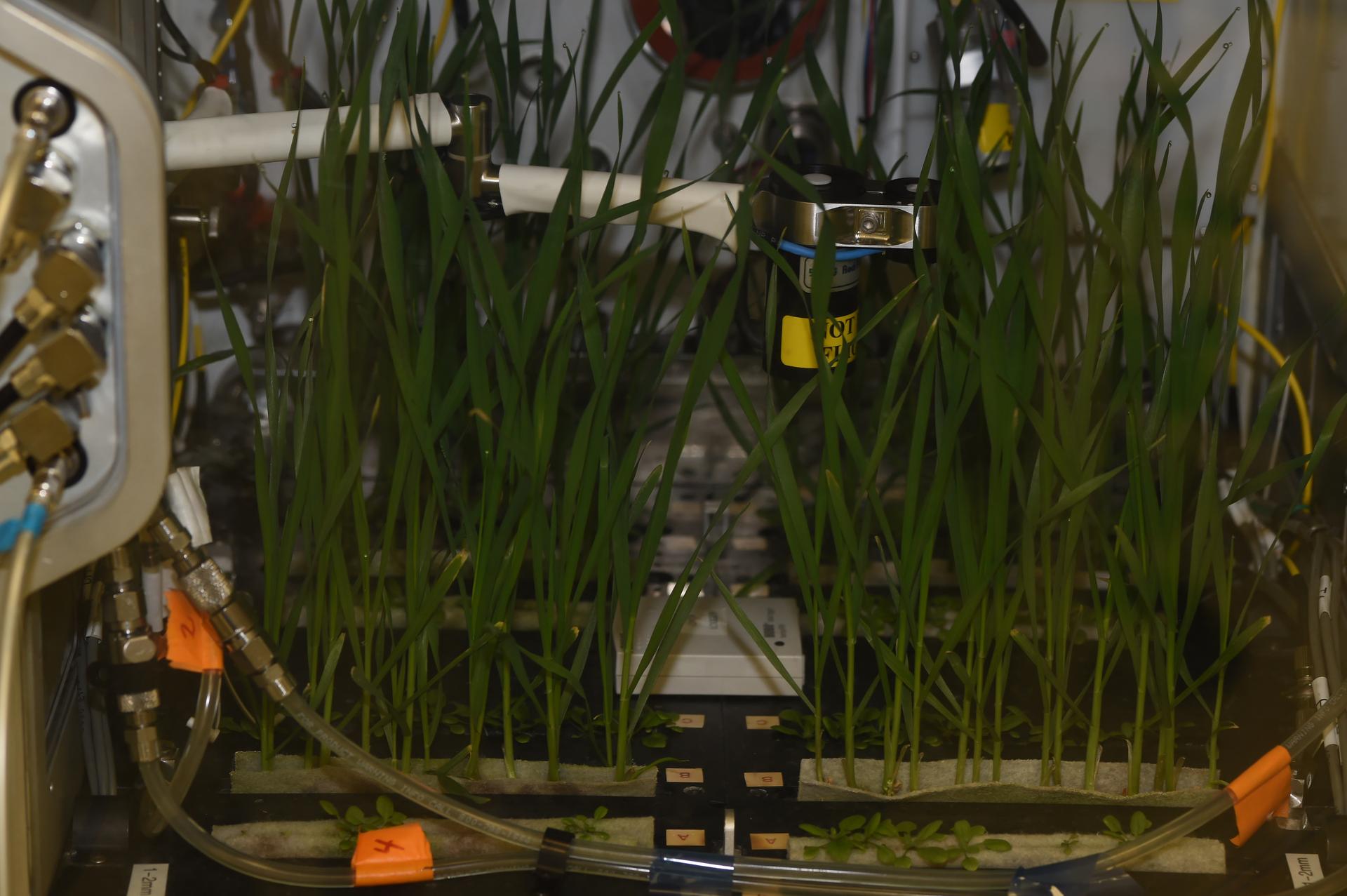
Fig. 17.1 A prototype of NASA’s Advanced Plant Habitat during a growth test at Kennedy Space Center. It is growing dwarf wheat, with smaller Arabidopsis plants between the rows. Much of the chamber is instrumentation. The sensors, water lines, and cables in the canopy are the parts a controller reads and commands. Image source: NASA.#
First, you operate the greenhouse by hand in the sandbox. Your team then uses Excel to analyze the telemetry log from the failed GHU-1 mission.
Next, your team turns what it learned into design ideas through four tasks.
Generating candidate designs
Modeling the trade-off between insulation and heat loss with linear regression
Sketching a greenhouse system
Evaluating alternatives through thought experiments
17.1. Tasks#
Task |
Who |
Deliverable |
|---|---|---|
Individual |
Gradescope activity |
|
Team |
One memo (PDF) and one Excel workbook |
|
Team |
Regression analysis and design choice |
17.2. Your Report This Milestone (TP2)#
Draft two sections of your Technical Report:
IV. Idea Generation and V. Thought Experiments. Section IV includes
functional decomposition, at least 4 AI-assisted ideas, and at least one other strategy (exploring prior art, rapid prototyping, biomimicry).
Also revise III. Problem Scoping after completing the milestone 2 assignments. Utilize your team’s telemetry log and insights from running the simulation.
Complete Table 2, Actuator owners, in section II. Team Member Roles. Name one owner for each actuator: the heater, the LEDs, the CO2 valve, and the irrigation pump. Each owner writes that actuator’s control function, fills in its rows of the parameter table, and runs its tuning cycles in Milestones 3 and 4.
Choose APA or MLA and use that style consistently for in-text citations and the corresponding entries in Section X. References.
Submit your report as one PDF per team, named TP2_design_project_report_team_#.pdf, with these sections drafted to 17.2 TP2: Design Project Report - Milestone 2 (Team) on Gradescope. Submit before the deadline listed on the Course Schedule.
Learning Objectives
- UC01:
Conservation Principles in Boundary Systems - Demonstrate an understanding of conservation principles (e.g., mass, energy, momentum, and/or change) applied to a defined system boundary.
- UC03:
Mathematical Modeling of Systems - Define engineering systems or processes using mathematical models that represent inputs, outputs, and accumulations.
- DV01:
Table and Plot Formatting - Prepare tables and plots for technical presentation with proper formatting. Include descriptive titles, axis labels with units, appropriately scaled axes, and visible legends.
- DV02:
Summary Statistics - Describe the central tendency (mean, median, mode) and variability (standard deviation, variance) of data using appropriate tools or methods.
- DV03:
Graphical Comparison of Data - Select, interpret, and justify appropriate graphical representations of data based on data type and structure. Use plots to compare distributions and identify patterns.
- DV04:
Regression Model Construction - Construct regression models that describe relationships between variables and support prediction.
- DV05:
Regression Model Evaluation - Evaluate and compare regression models using quantitative metrics (SSE, SST, and R²) and contextual reasoning.
- EB01:
Testing and Comparison - Test prototypes and analyze results to compare alternative solutions.
- EB03:
Data-Supported Justification - Justify decisions or comparisons using explicit reference to data.
- EB04:
Metrics and Weighting - Justify evaluation metrics and weighting based on stakeholder priorities.
- IF01:
Idea Generation - Generate a wide range of solution ideas, including non-obvious or combined approaches.
- IF02:
Use Ideation Strategies - Use and document multiple ideation strategies to generate ideas.
- PR05:
Code Structures - Understand and write sequential and non-sequential code structures to achieve a programming objective.
- PS05:
Problem Revision - Revise the problem statement based on new evidence or insights.
- SQ01:
Technical Accuracy - Use accurate scientific, mathematical, and technical concepts, units, and data.
- PC01:
Written Communication Standards - Use professional tone, clear sentence structure, and correct spelling and grammar in all written work.
- PC03:
Captioning Visuals - Include professional captions for all figures, tables, and plots that describe what is shown and why it is relevant.
- PC04:
Visual Communication of Engineering Contexts - Create visuals that clearly communicate engineering data, models, or concepts to a technical audience and support claims or conclusions.
- TM02:
Document Contributions - Provide clear evidence of individual contributions to the team’s work, including technical, written, or supportive tasks.
- IL03:
Supporting Claims with Evidence - Use data, examples, or published sources appropriately to support claims, assumptions, or recommendations.
- IL04:
In-Text Citations - Include appropriate in-text citations to indicate the source of information, data, or ideas.
- AI05:
Communicate clearly and effectively about AI usage and the choices surrounding it in a given field.
- EB06:
Reasoned Decision Explanation - Clearly articulate reasoning when evaluating alternatives or making decisions.